
Our Blog

How can I protect my child's teeth during sports?

July 8th, 2015

[caption id="" align="aligncenter" width="500"]How can I protect my child's teeth during sports? How can I protect my child's teeth during sports?[/caption]
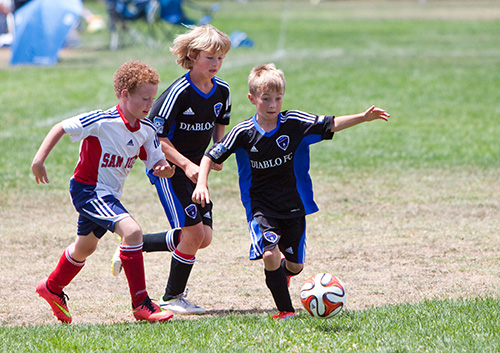
Sports are great for children for a variety of reasons. Children can develop their motor skills, learn how to solve conflicts and work together, and develop their work ethics. As a parent, you may recognize the benefits of sports, but also naturally worry about your child’s health and safety. Your job goes beyond providing a water bottle and making sure your child follows the rules of the game.

Although you may not think of your child’s teeth first when you think about sports, accidents can happen that affect your children’s teeth. A stray hockey stick, an errant basketball, or a misguided dive after a volleyball are examples of ways a child could lose a tooth. In fact, studies show that young athletes lose more than three million teeth each year.

Becoming a Better Athlete to Protect Teeth

Becoming a better athlete involves refining skills, learning the rules of the game, and being a good sport. These components are not just about winning. They are also about safety. Young athletes who are better ball-handlers and who are careful to avoid fouls and penalties are less likely to have harmful contact with the ball, teammates, or opponents. Children who are better roller-bladers are less likely to take a face plant into the blacktop, and more likely to save their teeth. Being a good sport and avoiding unnecessary contact is one way to protect teeth.

Proper Protective Equipment for Teeth

If your child is in a sport that poses a high threat to teeth, it is essential for your child to wear a mouthguard. Mouthguards fit your child’s mouth and consist of soft plastic. Dr. Allen Job can custom fit a mouthguard if generic ones are uncomfortable. While children may resist wearing a mouthguard initially, your persistence in insisting that they wear it should be enough to convince them. A helmet or face mask provides additional protection.

While prevention is best, rapid treatment can improve the situation if your child does happen to lose a tooth during sports. Rapid implantation can work in about ten percent of cases. To learn about ways to save a lost tooth, contact our San Diego, CA office.
Fun Facts for the Fourth

July 1st, 2015

[caption id="" align="aligncenter" width="320"]Fun Facts for the Fourth Fun Facts for the Fourth[/caption]

The Fourth of July is a great time to get together with friends and family members for BBQ, games, fireworks, and other celebrations in honor of our country’s independence. While your fellow revelers eat hot dogs and wave flags, you can impress them by sharing these fascinating facts and historical tidbits about some of our country’s traditions and symbols from the team at All Smiles Pediatric Dentistry.

The Statue of Liberty

With a torch in one hand and a tablet in the other, the Statue of Liberty is one of the most iconic and recognizable symbols of our country. However, as recognizable as certain parts of the statue are, not many people know that broken shackles, which represent oppression and tyranny, are lying at Lady Liberty’s feet. According to the Statue of Liberty-Ellis Island Foundation, the copper-plated lady weighs in at a whopping 450,000 tons and has been holding her torch up for more than 125 years, which must make for some impressive arm muscles.

Nathan’s Hot Dog Eating Contest

Since 1916, people have been flocking to Coney Island on the Fourth of July to witness what some people call the “superbowl of competitive eating.” Nathan’s Hot Dog Eating contest challenges competitors to devour as many hot dogs as they can in just ten minutes, with the current record holder swallowing a whopping 68 hot dogs! If you’d like to witness this bizarre and frenzied eating competition but you won’t be anywhere near Coney Island on the fourth, don’t worry. ESPN has been broadcasting this popular event for several years, so you can watch from the comfort of your couch while you eat a reasonably portioned meal.

The History Behind Fireworks

Viewing the nighttime fireworks display is exciting way to finish off the fourth. Many people know that these brilliant displays probably originated with the Chinese. However, many historians also believe that fireworks were stumbled upon when the Chinese roasted bamboo sticks over fires and watched them explode. After many years of roasting the sticks, a group of alchemists created an early form of gunpowder, which they stuffed into the bamboo sticks to create an even more powerful explosion, paving the way for the today’s modern fireworks.

Whether you’re planning on visiting the Statue of Liberty, watching fireworks in San Diego, CA, or even participating in a hot dog eating contest, Dr. Allen Job and our team hope you have a safe and fun-filled holiday. Happy Fourth of July!

The History and Mythology of the Tooth Fairy

June 24th, 2015

The History and Mythology of the Tooth FairyWhile the last baby teeth generally aren’t lost until age ten or 11, most children stop believing in the tooth fairy by the time they're seven or eight. Of course, children are more than happy to play along with the game when there’s money at stake! While it is impossible to know what the tooth fairy does with all those teeth (are they labeled and stored like museum pieces in a giant fairytale castle?), it is possible to trace the history and myth of the tooth fairy to several cultures and traditions. Dr. Allen Job and our team learned about some interesting myths about the tooth fairy!

The Middle Ages

Legend has it that Europeans in the Middle Ages believed a witch could curse someone by using their teeth, so it was important to dispose of baby teeth correctly. Teeth were swallowed, buried, or burned. Sometimes baby teeth were even left for rodents to eat. Despite being pests, rodents were valued for their strong teeth; it was generally believed a tooth fed to a rodent would lead to the development of a healthy and strong adult tooth.

Eighteenth Century France

The tooth fairy myth began to show more characteristics of a conventional fairytale in 18th century France. La Bonne Petite Souris, a bedtime story, tells the strange tale of a fairy that changes into a mouse to help a good queen defeat an evil king. The mouse secretly hides under the evil king’s pillow and defeats him by knocking out his teeth.

Scandinavian Lore

So, why does the tooth fairy leave money under the pillow? The idea of exchanging a tooth for coins originated in Scandinavia. Vikings paid children for a lost tooth. Teeth were worn on necklaces as good luck charms in battle. While the idea of exchanging a tooth for coins quickly spread throughout the rest of Europe, a fierce, horn-helmeted Viking is far cry from the image of a fairy collecting teeth.

While the tooth fairy as children know her today didn’t make an appearance until the 1900s, tooth myths and rites of passage have existed in numerous cultures since the dawn of time.

Treatment and Diagnosis for Your Child’s Teeth Grinding

June 17th, 2015

[caption id="" align="aligncenter" width="500"]Treatment and Diagnosis for Your Child’s Teeth Grinding Treatment and Diagnosis for Your Child’s Teeth Grinding[/caption]

The habit of grinding teeth can be both painful and harmful for your children. If you discover that they are frequently grinding their teeth—a condition called bruxism—here is some helpful information on the problem, and how you can find help to put a halt to it.

How to Know if Your Child is Grinding

Sometimes, identifying a child that grinds teeth is as simple as checking in while he or she is asleep. At other times, you may not be able to readily identify the grinding problem. A few of the most common symptoms associated with bruxism include:

  • Frequent teeth grinding or clenching of the jaw (in some cases it may be more subtle; in others it may be loud enough that you can hear it)
  • Teeth that are worn down
  • Complaints of sensitive teeth
  • Pain or tightness in the jaw muscles, or an earache or other jaw pain
  • Frequent unexplained headaches

In most cases, if your children are grinding their teeth, they will do it at night. If the teeth grinding is a result of excessive amounts of stress, it may also happen during the daytime. Some of the most common reasons children grind their teeth involve:

  • Improper alignment of top and bottom teeth
  • As a response to pain, especially for tooth, jaw, or gum pain
  • Excessive stress, tension, or anger

Treatment Options for Bruxism

In many cases, children will grow out of the teeth grinding as their permanent teeth develop, replacing poorly aligned or painful baby teeth. If your child grinds his or her teeth more frequently, or you begin to notice significant damage, it may be more serious and need to be addressed by Dr. Allen Job before it causes more permanent pain or problems.

In some cases, our team at All Smiles Pediatric Dentistry may recommend that your child wears a protective mouthguard to prevent grinding, or work with a therapist or other specialist to develop awareness of the grinding. If the grinding is caused by stress or anxiety, it may be helpful for you to sit down and talk to your child each day about how she is feeling, and why, to help her work through the stress.

Teeth grinding can be a painful, problematic condition for some children. However, a combination of parental vigilance and frequent visits for regular checkups at our San Diego, CA office can help. If you are concerned that your child may be grinding his or her teeth, and it could cause permanent damage before the child grows out of it, come talk to us about strategies for dealing with bruxism, and ways for you to help your child.